
THE ISÈRE · SAVOIE · TARENTAISE — 6 RAPIDS · CLASS IV
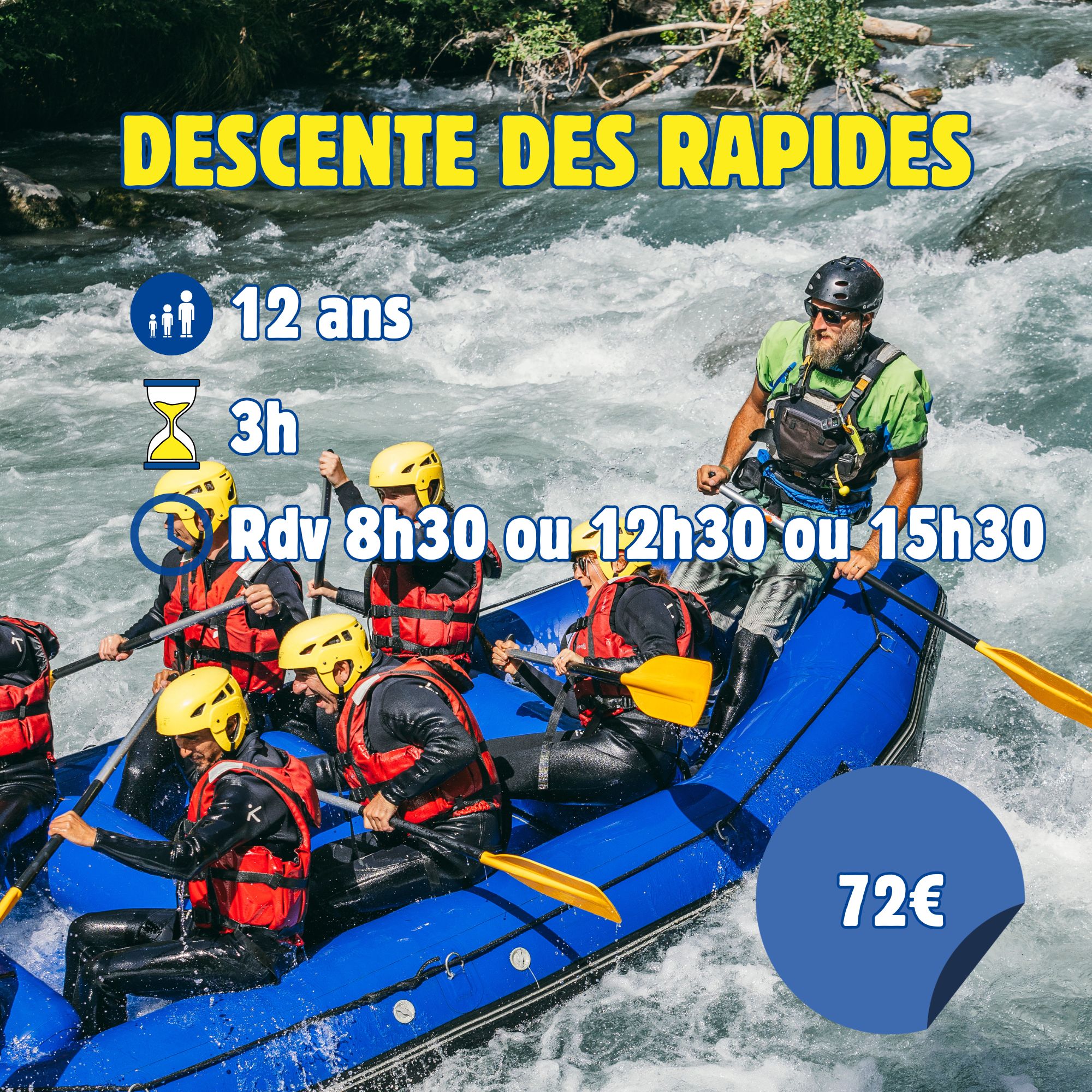
Two kilometres. Six rapids. One Class IV. The rapids of Aime are the heart of the Isère, in the Tarentaise valley — the stretch that has built its reputation for forty years. There is a moment in the descent when the mood shifts: the guide stops joking, sits up, looks far ahead, and drops the line everyone is waiting for without knowing it: “Right, we’re entering the rapids of Aime.” Here is what awaits you, rapid by rapid.

Two kilometres that built the Isère’s reputation
The rapids of Aime are not a single rapid you clear before drifting on. They are a sequence — a string of features that follow one another without letting you catch your breath. They fill the last kilometres before the Aime bridge, and they are graded Class IV — the level where the river stops carrying you and starts testing you.
Before them, the river eases you in: the Gothard rapids, Class III, offer waves and rollers on which the crew learns to paddle together. By the time the rapids of Aime arrive, you are no longer passengers.
Their difficulty is not one major obstacle to clear. It is continuity. In whitewater you never judge a rapid alone — you judge it with whatever comes right after. And here, what comes right after is always the next rapid.
A detail few people know: each rapid is marked by a sign along the cycle path that runs beside the Isère on the left bank. So you can scout them on foot or by bike, dry, before running them.
1. The Ham Slicer (La machine à couper le jambon)
It’s the first one, and the one whose name everyone remembers long before setting foot in a raft. The explanation is simpler than anything you might imagine: there is a boulder in the middle of the rapid, and it is shaped like a ham slicer. That’s all. Someone came by one day, looked at the block in the current, saw the slicer of a village grocery, and the name stuck.
Look for it as you pass — you’ll see it, or you won’t, depending a lot on the water level and a little on imagination. It opens the series and sets the tone: a sustained, dynamic rapid with no let-up. From here, the crew paddles together or not at all.
2. The 400 Metres
This one doesn’t look like much in a photo. Yet it is the most serious of the series — not for the violence of the drop, but for what comes behind it. Its name tells you exactly what matters: if someone falls in, recovery is hard for 400 metres. No comfortable eddy, no beach, no branch to grab.
This is the kind of section you listened to the safety briefing for at the start — and the kind where a state-qualified guide is not a comfort but the very condition of the trip.
3. The Sheep
A small drop — a step in the river that the raft takes nose-first before straightening up. Enough to bring the rhythm back after the long, escape-less run of the 400 Metres. “Sheep”, in whitewater, are those white, foamy crests that form when the current breaks. From the boat, they file past like a crossing flock.
4. The Vines
Here the difficulty has a technical name: a push to the right bank. The current doesn’t run straight — it shoves the whole mass of water sideways against the right bank. Give in to it and you end up pinned against the shore; anticipate it and you pass wide without feeling a thing. It’s a rapid of positioning, not power: the guide sets the angle, the crew provides the drive.
5. The Dining Room
The name is a guide’s joke, but the obstacle is very real: a wave that blocks the whole width of the river. A stopper wave is water falling back behind an obstacle and rolling upstream on itself. You can’t go around this one: it spans bank to bank. So you hit it head-on, with speed, and above all keep paddling while the boat rears up — the exact moment instinct says to hold on, and the guide shouts “paddle!”. You come out soaked. That’s the point.
6. The Dessert
The last one. A name you only understand as you run it: it’s what comes after the dining room, of course. Two things to know. A push to the right bank, as at the Vines, to be negotiated when the crew already has two kilometres of Class IV in their arms. And above all: above 50 m³/s it builds a big stopper wave. The same rapid, at two different flows, simply isn’t the same rapid.
Flow changes everything
This is the point the videos never show. On the Isère, the volume of water varies with the season, the snowmelt and the power plant’s turbines. A rapid is not a fixed set: it is a shape of water that builds and reshapes with the flow running through it.
- Around 20 m³/s — the guaranteed floor during the rafting season. The river is runnable and the lines stay readable.
- Between 25 and 40 m³/s — the fun zone. Enough water for the waves to really form, not so much that everything gets committing.
- Above 50 m³/s — a different river. The hydro plant tops out around 45 m³/s of turbined water; above that it is natural water (spring melt, heavy storm, flood). That’s when the Dessert shows its big wave.
In practice: at medium flow, the rapids of Aime are a sporty yet very accessible run with a good guide. In high natural water, they become a genuinely committing whitewater section. That’s why the day’s run is decided on the day, based on the level.
See them from the cycle path
Our best tip, and it’s free: go and scout them first. The cycle path follows the Isère on the left bank along this whole stretch, and each rapid is marked by a sign. An hour’s walk or ride, and you’ll have seen the Dining Room’s stopper, the Vines’ push, the long escape-less run of the 400 Metres with your own eyes. Perfect the day before your descent, for friends and family who aren’t paddling, and on big-water days.
How to run them with AN Rafting
The rapids of Aime are part of our rafting descents in Savoie on the Isère. Depending on the trip and the day’s water level, you’ll link them with the Centron gorges, steeper and wilder. No previous experience is needed — being able to swim, yes. All gear is provided, trips are led by state-qualified guides, and the safety briefing is part of the outing.
Book my rapids of Aime descent →
Frequently asked questions
What are the names of the rapids of Aime?
In running order: the Ham Slicer, the 400 Metres, the Sheep, the Vines, the Dining Room and the Dessert. Each is marked by a sign on the cycle path that runs beside the Isère.
Why is this rapid called the Ham Slicer?
Because of a boulder in the middle of the rapid whose shape looks like a ham slicer. The name comes from that and nothing else — a guide’s observation that became the best-known place name on the Isère.
Are the rapids of Aime suitable for beginners?
Yes, when guided. They are graded Class IV, but a raft led by a state-qualified guide absorbs that difficulty: your job is to paddle when asked. You must be able to swim and have no medical contraindication.
When is the best time to run them?
From June to September for the rafting season, with a guaranteed minimum flow. June usually offers the biggest volumes thanks to the snowmelt.
Can you see the rapids without rafting?
Yes. The cycle path runs beside the river on the left bank and each rapid is signposted. It’s accessible on foot or by bike, free of charge.